
Use Agent Toolkit
People
Durable collaborators, reusable definitions and real runtime sessions.
CANONICAL SOURCEView this guide in GitHub ↗
People — durable collaborators, not running sessions
Status: PARTIAL PRODUCT DELIVERY — Desktop supports roster CRUD, reviewed
one-way Munder import, and starting a discovered runner as a real local PTY
bound to a Person and project. The V backend records session identity and
lifecycle history; Electron remains the process/PTY owner. A configured Person
stays offline unless a matching local PTY is alive. The local PTY enforces
max_seconds; token and cost limits and non-inherited isolation are disclosed
as unsupported and need explicit acknowledgement. Provider conversation IDs,
resume, and process continuity across app exit are not implemented; see
Gaps.
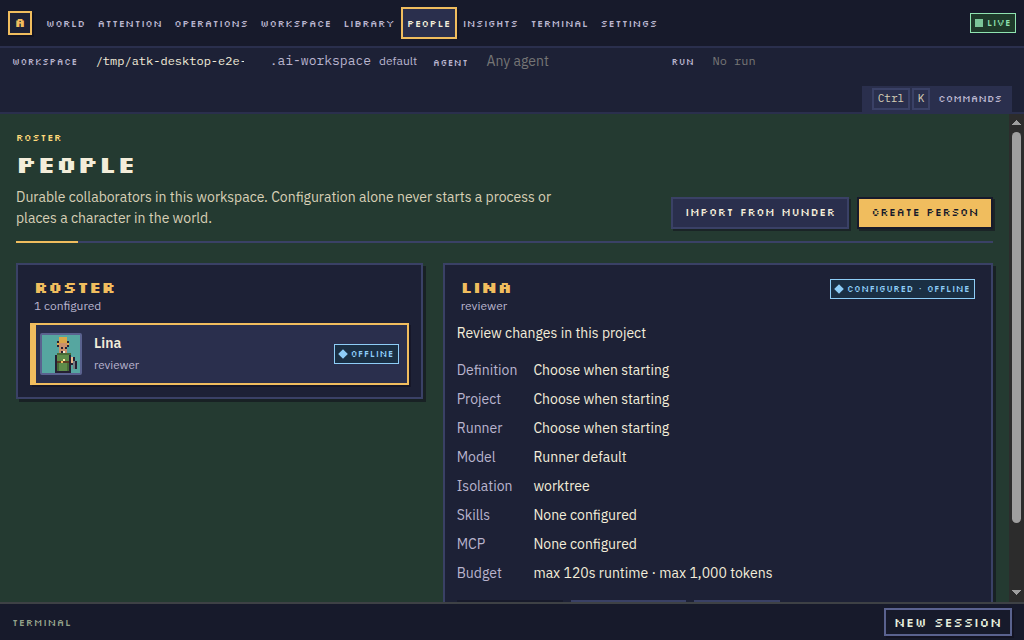
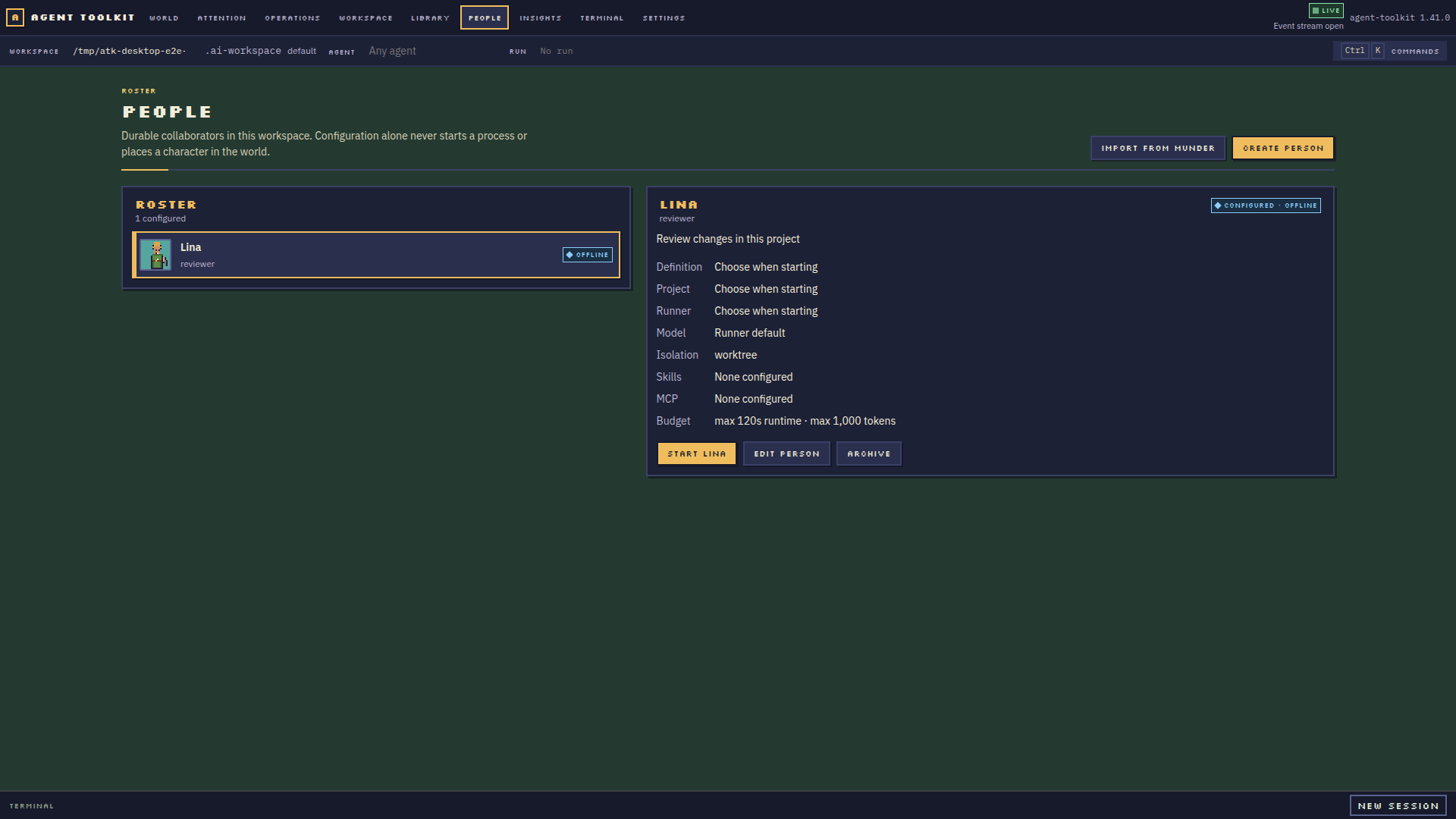
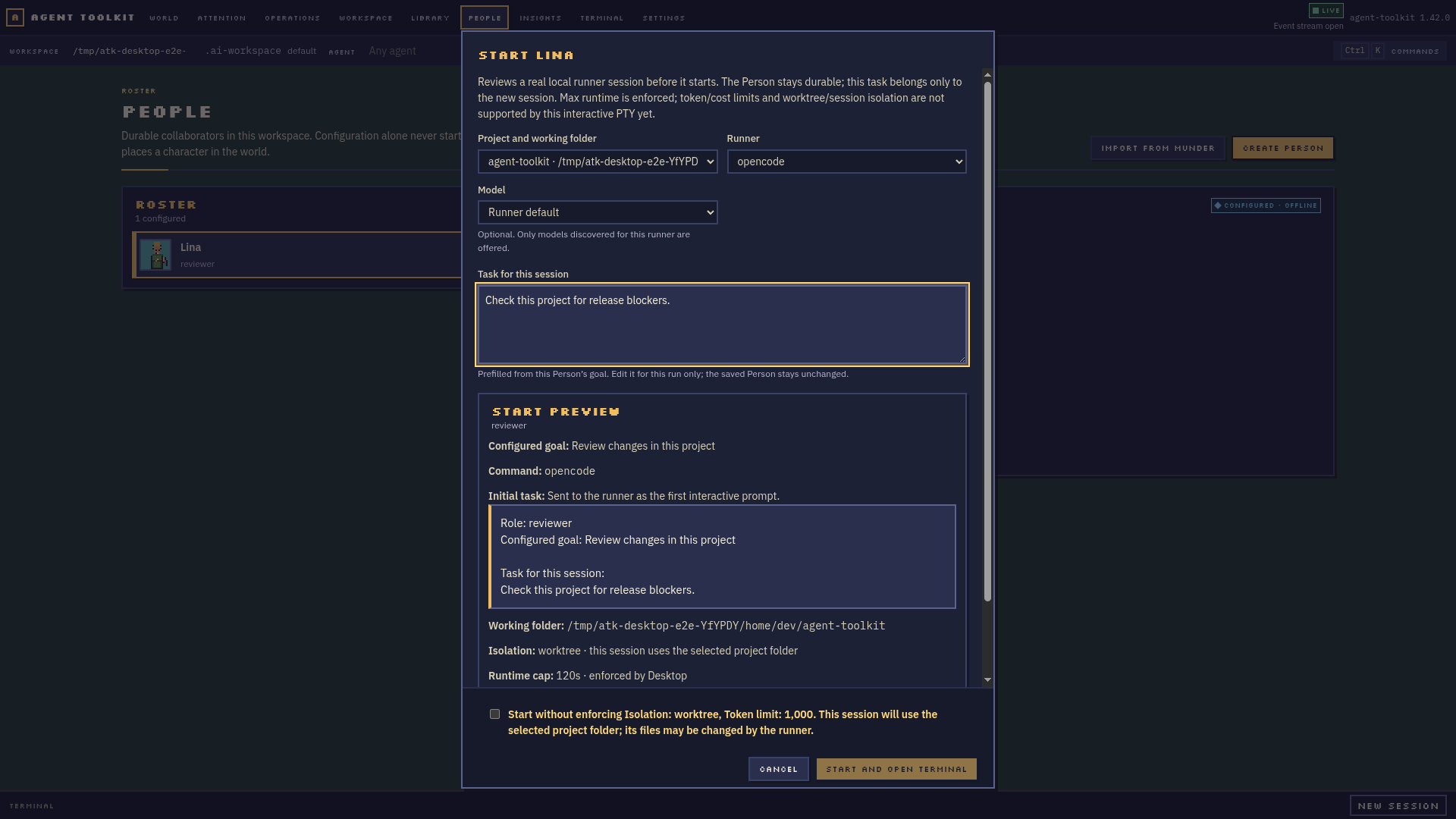
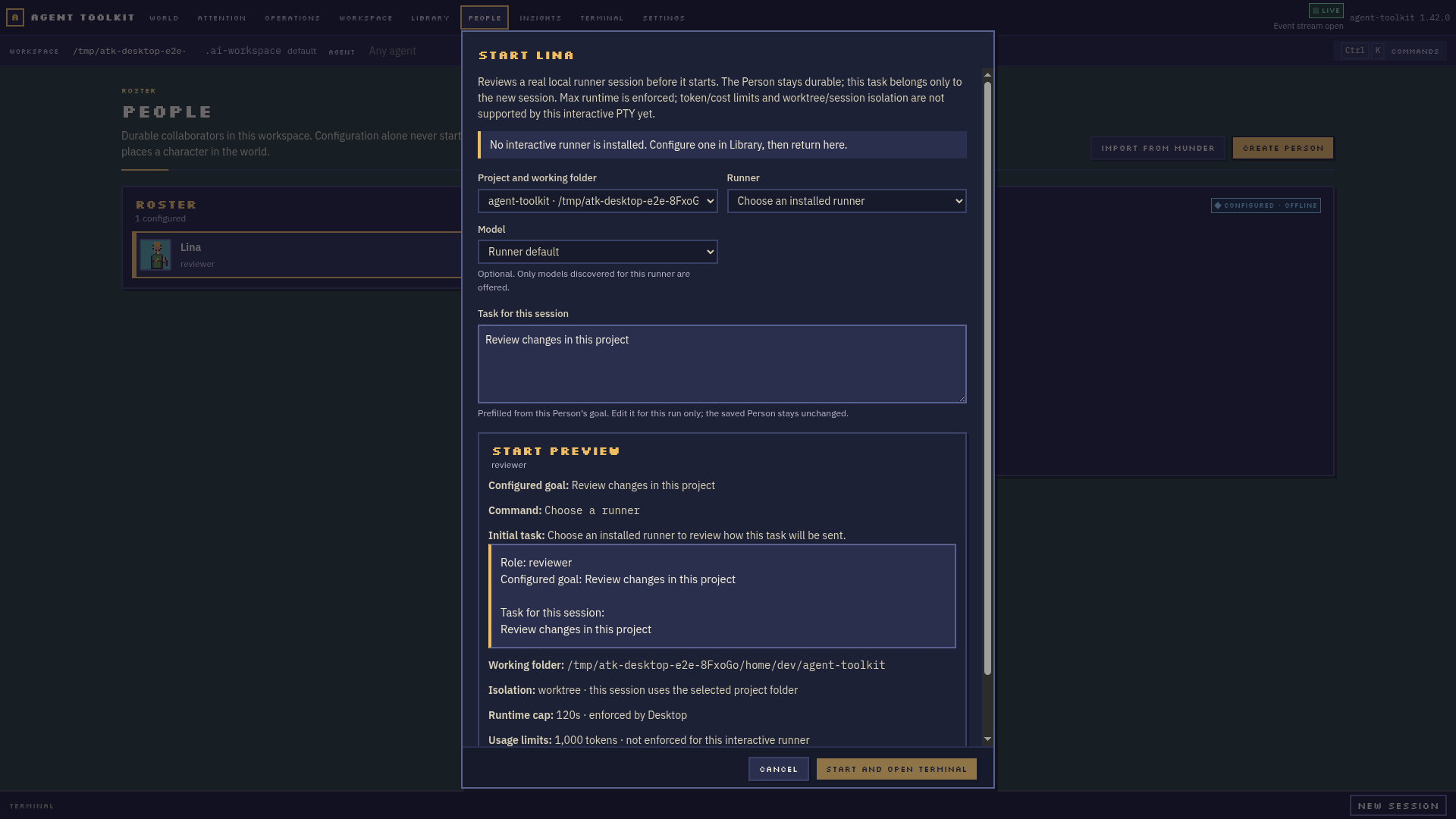
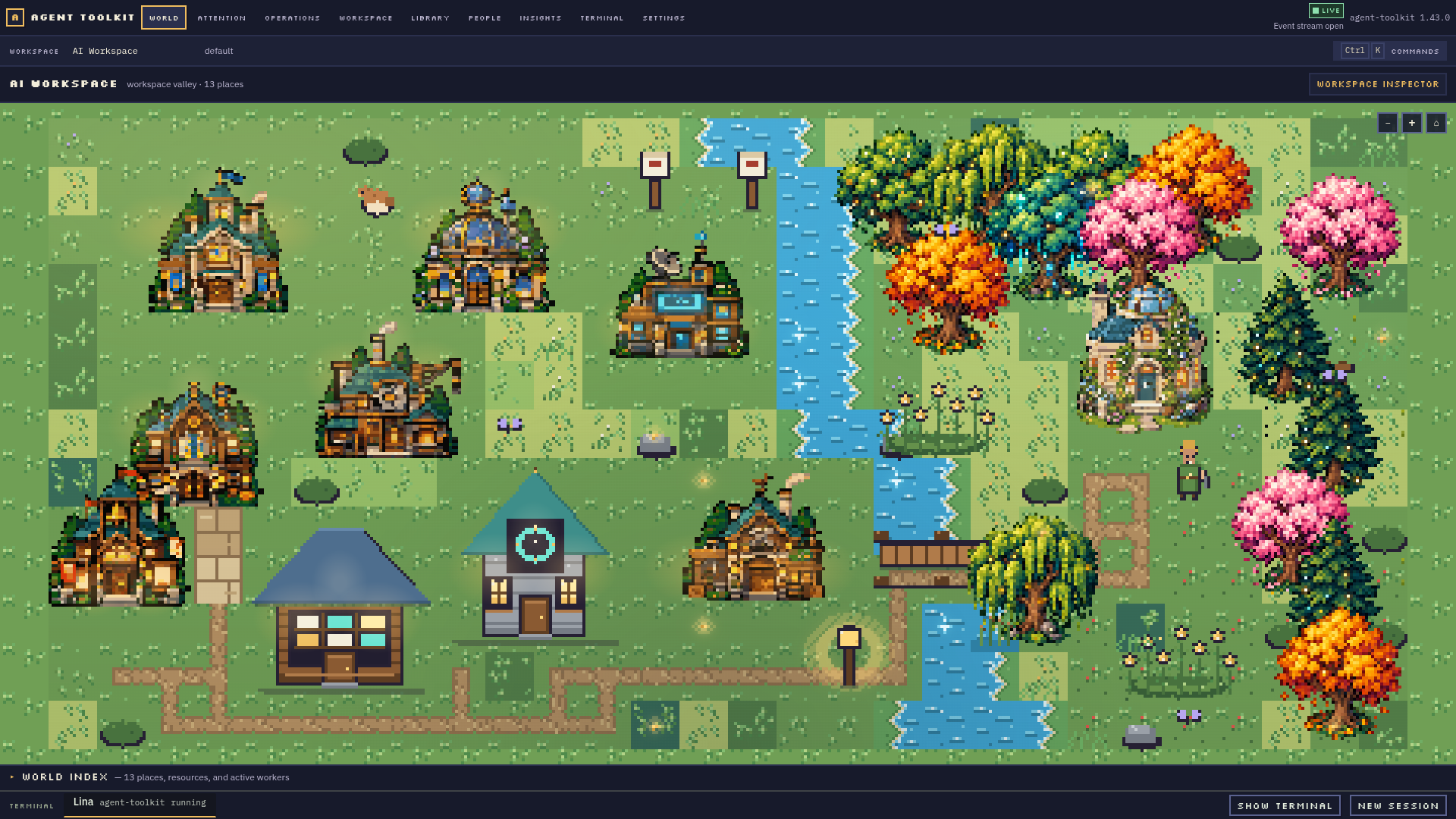
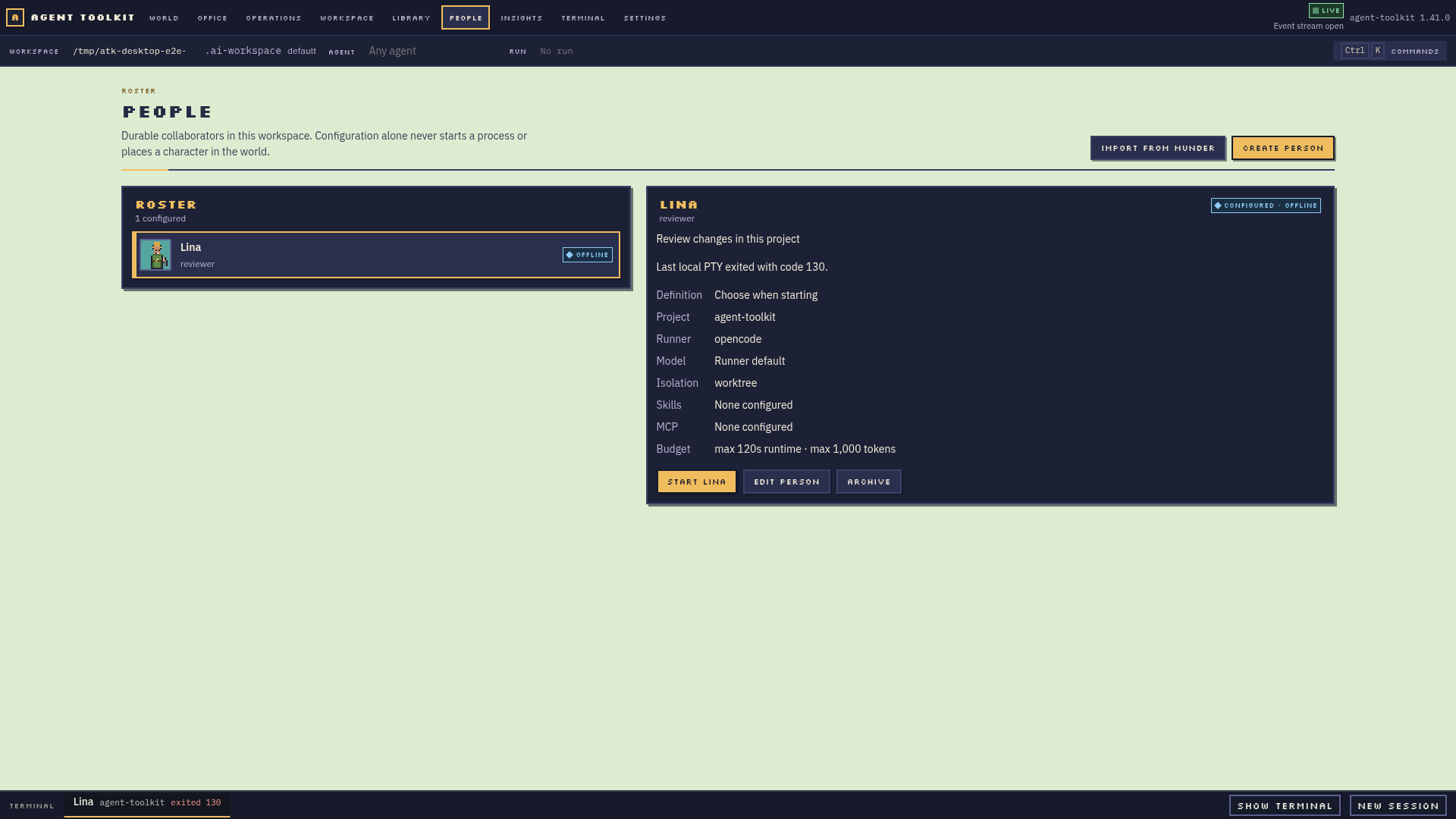
The screenshots below were captured from the live Electron app and backend at both compact and large sizes. A configured Person is offline until a real PTY starts. The world shows the selected Person only while that PTY is alive and assigned to a registered project.
Screenshots
Compact roster
Large roster
Start review with an available runner
Recovery when no runner is installed
Real Person session in the world
Person after the PTY stops
A Person is a collaborator you have chosen and reviewed. It persists in your
workspace, not in the toolkit. Configuration alone never creates a character:
a people/<id>.json file is a declaration. The current Desktop slice uses
Electron’s real PTY state plus the saved Person/project association to project
presence; it does not infer activity from People declarations or fabricate
output.
Identity model
These five things are different, and the code keeps them different:
| Concept | Where it lives | What it is |
|---|---|---|
| Agent definition | toolkit agents/<name>/AGENT.md |
A reusable persona template — how an AI works in a session |
| Agent profile | toolkit profiles/<target>/ |
A per-target adapter/overlay of toolkit capabilities |
| Person | workspace people/<id>.json |
A durable collaborator you chose and reviewed |
| Agent session | workspace .agent-toolkit/sessions/<id>.json + Electron PTY |
Durable lifecycle record joined to one local runner process; provider conversation state is not captured yet |
| Swarm role | recipe | A slot in a swarm run, resolved per run |
Workspace personas (personas/*.md) constrain behavior and permissions during
a session; they are not identity. A Person composes an optional
definition_id reference plus preferences, but is its own durable thing.
Storage
<workspace>/
  people/
    README.md              scaffold (workspace init)
    <id>.json              one Person per file, spec agent-toolkit/person@1
    bindings.yaml          optional role preferences, spec agent-toolkit/people-bindings@1
  scripts/
    validate-people.py     mirrored offline validator (canonical: toolkit scripts/workspace/validate-people.py)
  schemas/
    person.schema.json     mirrored (canonical: toolkit schemas/person.schema.json)
    people-bindings.schema.json
    people-contracts.lock.json  SHA256/source lock for the mirrors
  .agent-toolkit/
    sessions/
      <session-id>.json    V-owned PersonSession lifecycle evidence
workspace init scaffolds people/README.md and rejects symlinked
destinations before writing anything. The mirrors are written by
scripts/sync-people-contracts.py from the toolkit checkout (atomic
replacement, so unrelated hardlinked inodes survive) and verified against the
lock before the validator parses any schema. A drifted mirror fails validation
with a static message; it never evaluates tampered schemas.
Schema rules (agent-toolkit/person@1)
- Required:
spec,id,name,role,goal,archived. - Optional:
definition_id,avatar,preferred_provider,preferred_model,capabilities,skills,mcp_servers,isolation,budget,import_source. idis lowercase[a-z0-9][a-z0-9_-]*(max 64) and must match the filename.- Reference arrays are bounded at 32 unique entries.
- No runtime fields, no secrets, no commands, no environment, no grants.
- Source flags (
import_source.*) are inert provenance, never instructions. - Budget omission means inherited or unknown, never unlimited.
additionalProperties: falseeverywhere.
Imports (munder-difflin/hire@1)
capabilities/imports/munder-hire-v1.json defines the one-way mapping:
review_required: true, auto_spawn: false, auto_install: false,
live_sync: false. It maps name/role/goal/provider/model/skills/MCP fields;
the definition_id is chosen during human review. The Desktop importer shows
ignored fields before an explicit save; it never executes or persists embedded
commands. Original character/accent are retained as inert attribution, not
external art. Never treat hive/registry.json as runtime authority; there is
no live synchronization.
Validation
python3 scripts/validate-people.py --workspace <workspace>Offline only: the validator uses a no-network jsonschema registry, rejects
symlinked directories/files, enforces the 64 KiB declaration limit, the
id/filename match, finite numbers (rejecting NaN/Infinity/1e9999),
duplicate keys, and prints a static diagnostic that never echoes values, keys,
or control bytes. Templates under templates/people/ are validated but never
counted as configured people.
Swarm role binding
When a swarm recipe names a role:
Desktop lets the user assign one active Person to each canonical recipe role
before starting. The live backend preview resolves each role in the same way
the run will: an explicit selection wins, then one unused active Person whose
saved role or definition_id matches the recipe slot, then an ephemeral
recipe role. The review names each selected or matched Person and shows the
ephemeral fallbacks before Start. Roles remain ephemeral responsibilities; the
Person ID is stored with the run and exported as AGENT_TOOLKIT_PERSON_ID to
that role’s adapter process, including roles started after handoff. This is
currently run metadata and an environment hint: Agent Toolkit does not yet
consume it to associate the process with a canonical AgentSession, terminal
action, or World character. The backend rejects unknown roles, missing or
archived People, and duplicate assignments.
The launch_sessions API option starts real Herdr/tmux role processes without
attaching the server request to an interactive terminal. Headless mode records
run state only and rejects a request to launch sessions. Runner and model are
still selected for the swarm as a whole; saved per-Person runner/model
preferences are not applied by this runtime. The run inspector resolves stored
Person IDs against the current roster and shows the durable name, role, and
saved runner/model preferences. If that Person was later archived or removed,
the inspector explains that the live roster entry is unavailable. Preferences
are informational only; they do not imply the swarm used that Person’s runner
or model. Runtime presence is not projected into the World from swarm bindings
yet, and a binding alone never creates a PersonSession or character.
In the Start Swarm review, Remember stores the selected Person as a
workspace default for that recipe role. The UI shows the pinned Person and any
ordered fallback People returned by the backend. Clearing the pin preserves
the fallback list and returns resolution to those fallbacks, compatible role
matching, then an ephemeral role. These controls use the typed
GET/PUT /api/v1/people/bindings endpoints; no YAML editing is required.
Desktop implementation
The People destination lists configured and archived collaborators, and lets
the user create, edit, archive and restore them. The V server validates writes
against the durable declaration shape, stores people/<id>.json atomically,
and rejects symlinked storage. The import picker accepts a local
munder-difflin/hire@1 JSON file, previews every mapped domain field and the
names of ignored fields, and requires a separate save action. Saving or
importing never starts a process. The Start review selects a real project,
discovered runner and optional runner model. It preloads the Person’s durable
goal into a one-time editable task field, then previews the exact initial
prompt (role, goal and task) before Start. The task is not written back to the
Person or stored in the canonical PersonSession lifecycle record. OpenCode,
Claude, Codex and Copilot receive it through their documented interactive
prompt options; runners with no verified option open normally and offer a
copy action. The V backend validates the Person, linked project and provider,
resolves the canonical working folder, and writes
.agent-toolkit/sessions/<id>.json with launching
before Electron opens the runner through node-pty. Electron reports running and terminal lifecycle outcomes;
on startup, Desktop reconciles active records against PTYs still owned by its
main process and records missing processes as interrupted. The PTY carries the
V session ID, Person ID and project ID so a living process can be inspected
from the world and reopened in Terminal; stopping/reaping it leaves the Person
untouched. This record is lifecycle evidence, not a provider conversation
transcript or resumable session. The portrait uses original Toolkit sprites;
source appearance is attribution only. Operations also offers explicit Person
assignment per swarm role, validates the choice against the workspace roster,
and can launch real adapter-backed role sessions.
Gaps
The following are explicitly not implemented. Do not represent schemas or file authoring as the user interface:
- Runner-specific provider session IDs, conversation history, safe resume, and keeping a process alive after Desktop exits. The durable lifecycle record remains, but Desktop marks a missing PTY as interrupted rather than claiming the provider conversation can resume.
- Cursor and Muse currently open interactively without a submitted initial task because their runner-specific interactive prompt contracts have not been verified. The Start review lets the user copy the reviewed prompt into those terminals.
- Runtime enforcement of token/cost limits and non-inherited isolation for the
local PTY Start flow.
max_secondsis enforced by Desktop and stops the PTY when its time budget expires. - Per-role runner/model preference enforcement, an Agent Toolkit consumer for the swarm Person environment hint, swarm-process terminal reopen/stop from Desktop, and truthful swarm-session projection into the World.
Explicit assignment wins. The backend then applies ordered preferences from
people/bindings.yaml, followed by automatic matching by saved role or
definition_id; any unmatched role remains ephemeral. Workspace role defaults
are configured from the reviewed Desktop swarm start flow; the YAML file is an
interoperability format, not the user interface. Per-role runner/model
preferences are not applied yet.